“Utter madness” - Devon MP slams Government plans to weaken flood protection

A Devon MP has opposed fiercely Government proposals to water-down important and established protections against flooding in national planning guidance.
Richard Foord, MP for the Honiton & Sidmouth constituency, condemned the proposals that are being consulted on by the Government, as part of changes to the National Planning Policy Framework.
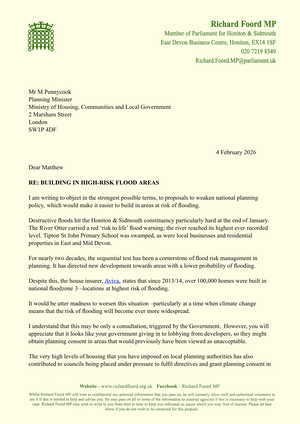
Mr Foord has written to Planning Minister, Matthew Pennycook, describing the proposed changes as “utter madness.” Mr Foord told Mr Pennycook in a letter dated 4 February, that he was writing to object to the proposals, in the strongest possible terms.
Mr Foord referred to Storm Chandra, which left a trail of destruction in its wake last week. Foord informed the minister of the damage caused, including the consequences for residents of the River Otter reaching its highest ever recorded level. He pointed to Tipton St John Primary School, as well as local businesses and residential properties across East and Mid Devon.
He said: “We have had the “sequential test” for almost two decades, which has been at the heart of flood risk management in planning. Its purpose is to direct new development towards areas with the lowest probability of flooding.”
Despite the existence of that test, the house insurer, Aviva, states that since 2013/14, over 100,000 homes were built in national floodzone 3 – locations at highest risk of flooding.
Mr Foord added: “It would be utter madness to worsen this policy, which already falls short – particularly given that climate change will mean that the risk of flooding will become ever more widespread.
“The very high levels of housing proposed by this government has also exacerbated the risk of communities being flooded, and contributed to councils being placed under unreasonable pressure to grant planning consent in inappropriate areas.
“The Environment Agency is expert in mitigating flood risk and has updated its flood map for planning, significantly expanding the number of areas now classified as at risk from surface water flooding.
The long-established precautionary principle in relation to flooding is at risk of being swept away if this weakened policy approach is adopted.
Mr Foord urged Mr Pennycook to “reconsider these proposals and instead, strengthen the flood-risk precautionary principle, to help protect the constituents who I represent, and citizens across the country.”